Insights into our collections
Wisley’s Staghorn Fern: A Century-Old Marvel
Stroll through the Millenium Glasshouse at RHS Garden Wisley and you will encounter a living marvel of horticulture: a staghorn fern which has been part of the RHS collection for over a century.
Yvette Harvey is the Keeper of the RHS Herbarium and is responsible for the Society’s collection of over 90,000 dried, cultivated plant specimens, as well as 3,500 paintings, 35,000 photographs and collectors’ notes, and a devoted team of curators, digitisers and volunteers.
What is a staghorn fern?
Native to the tropical and subtropical forests of Australia and Southeast Asia, the staghorn fern Platycerium bifurcatum is an epiphyte, meaning it grows upon other plants – usually trees – rather than in soil. Its fronds, resembling antlers, serve both aesthetic and functional purposes. Its green strap fronds capture and funnel water to its brown shield fronds that trap organic debris and water.
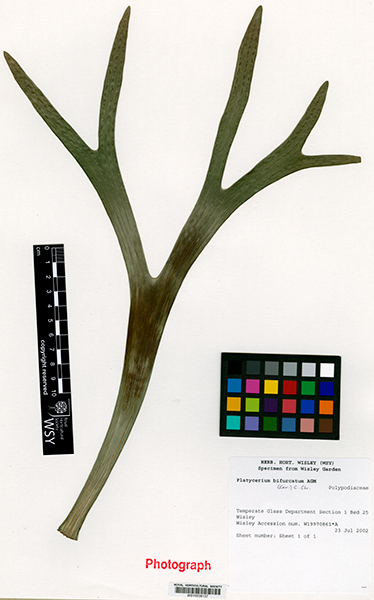
RHS Herbarium specimen of the Millenium Glasshouse Centenarian Platycerium bifurcatum
The long and storied life of Wisley’s staghorn fern
The RHS’ remarkable staghorn fern, represented both as a living specimen and as a pressed specimen in the herbarium, is over a hundred years old. It was initially grown in the Horticultural Society’s first official garden at Chiswick, a historic site that helped shape the very foundations of modern gardening.
The Chiswick garden was established in the early 19th century as a hub for experimenting with the latest horticultural techniques, and acclimatising plants that had recently been introduced to the UK. It was in this historic setting that our venerable staghorn fern lived out its early years.
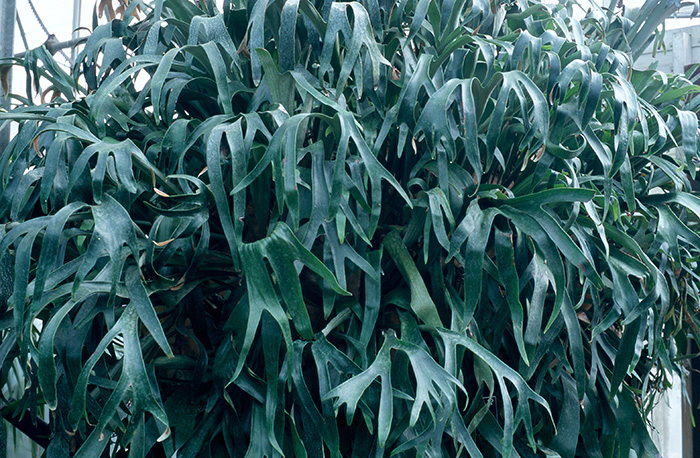
The staghorn fern in the Wisley Millennium Glasshouse in 2002. Credit: RHS / Graham Titchmarsh
Over the course of its long life, the Wisley staghorn fern has seen enormous change, including the tail end of the Industrial Revolution. By the late 19th century, Chiswick’s population had grown from 6,000 to 40,000, and smog from new local railways and coal fires in homes had begun damaging the garden’s glasshouse and plants – but still the fern survived. When the RHS eventually succeeded in its aim of opening a new garden away from the city fumes at Wisley, the fern moved too. Subsequent decades would bring yet more moves, as successive new glasshouses at Wisley became the fern’s home.
The fern’s survival through decades of changing horticultural fashions, environmental conditions and locations speaks volumes about its resilience and adaptability. Few plants can boast such a lineage, making this specimen a living piece of horticultural heritage and a symbol of botanical endurance.
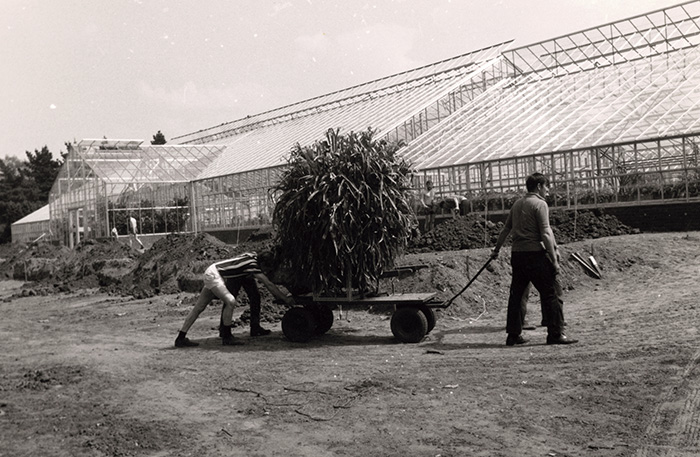
Moving our Platycerium during a hot day in the late 1960s. Prior to its home in the Millenium Glasshouse, the fern had lived in Wisley’s previous glasshouse on top of Battleston Hill (where the herbarium is now located) and prior to that in the glasshouses that were replaced by the Jellicoe Canal.
What makes Platycerium bifurcatum unique?
Aside from its age, what truly sets this plant apart is its cooperative survival strategy, discovered by Professor Burns of the Te Herenga Waka Victoria University of Wellington, New Zealand. Unlike most plants that operate alone, staghorn ferns often grow in colonies on trees and work together to share resources. Ferns living higher up the tree have erect fertile strap fronds, better for water capture, whilst those lower down have sterile, drooping strap fronds and spongy, water storing shield fronds. The latter sacrifice their chance of reproducing for the survival of the colony in these challenging environments.
This rare communal living arrangement is one of the most intriguing traits in all of plant behaviour, and has drawn comparisons to eusociality, a term typically reserved for insects such as ants and bees. Eusociality is characterised by cooperative brood care, overlapping generations, and division of labour. While plants lack the mobility and behavioural complexity of animals, staghorn ferns exhibit a striking parallel. Their shield fronds act as a communal resource hub, and their growth patterns suggest a form of altruism: sacrifice themselves to nourish the colony. This phenomenon challenges traditional notions of individuality in plants and opens intriguing questions about the evolution of cooperation.
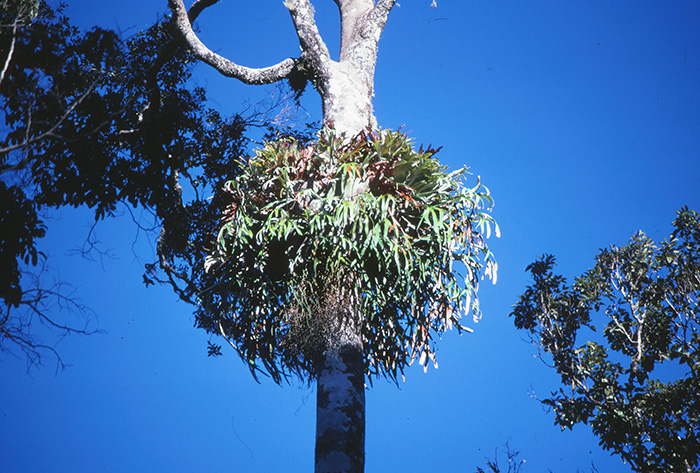
Platycerium bifurcatum growing on a tree in Bunya Mountains National Park in Queensland, Australia, in the 1980s. Credit: John Robert McPherson.
A Living Symbol of Botanical Wonder
Our century-old Platycerium bifurcatum is more than a plant; it is a narrative of endurance, adaptation, and interdependence. From its roots in the RHS Garden at Chiswick to its role as a model for plant sociality, it invites us to rethink what it means to live collectively. In an era where biodiversity faces unprecedented threats, this fern reminds us that cooperation – whether among plants or people – can be the key to survival.
Discover more
Author
Yvette Harvey, Keeper of the RHS Herbarium
Published
21 April 2026
Insight type
Short read