Insights into our collections
Chiswick: The First RHS Garden That Shaped Horticultural History
When the Horticultural Society of London was founded in 1804, it had no garden of its own. Yet within two decades, it would open a pioneering site at Chiswick that would shape British horticulture for generations
A Garden Takes Root
In its early years, the Society relied on private gardens and nurseries to house the many plant gifts and specimens it received. Temporary plots leased in Kensington and Ealing soon proved too small. Everything changed when, in 1821, the Duke of Devonshire offered the Society 33 acres of land close to Chiswick House in West London. The Society’s first official garden opened in April 1823.
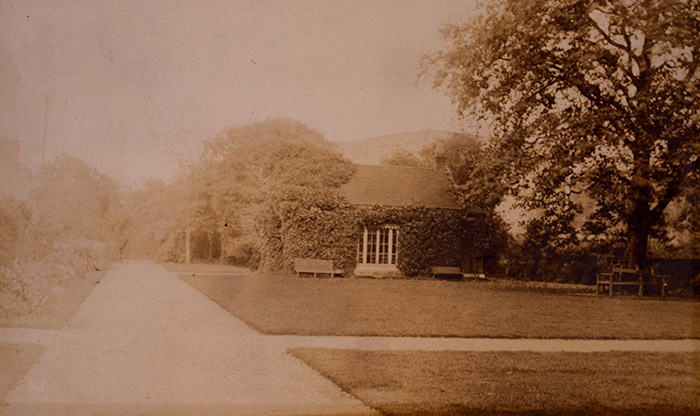
Photograph of the Council Room at RHS Garden Chiswick, c.1900. RHS/P/WY/1/18/11
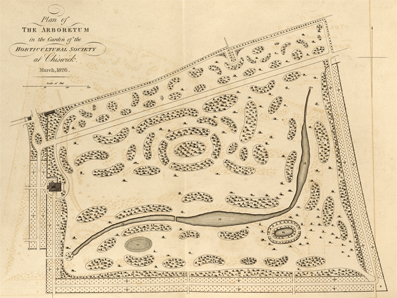

Left: Plan of the Arboretum in the garden of the Horticultural Society at Chiswick, March 1826
Right: Plan of the garden of the Horticultural Society, April 1823
A Centre for Experimentation
The Horticultural Society’s Chiswick Garden was thoughtfully laid out with an orchard, kitchen garden, arboretum, glasshouses and ornamental flower beds. Gardeners tested the latest techniques and varieties in experimental plots. Fellows could visit with guests, and the public were admitted for a fee - provided they followed the rules: no picking, no tipping the employees, and no Sunday visits.
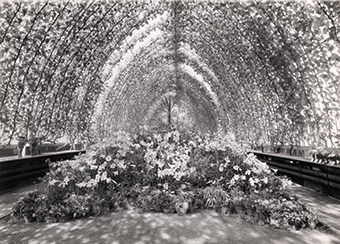
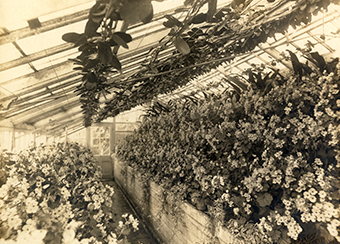
Left: Photograph of the vinery at the RHS Garden Chiswick, c.1900. RHS/P/WY/1/13/E/1
Right: Interior of a conservatory at the RHS's former garden at Chiswick, c.1900.
Fruit First: Classification and Cultivation
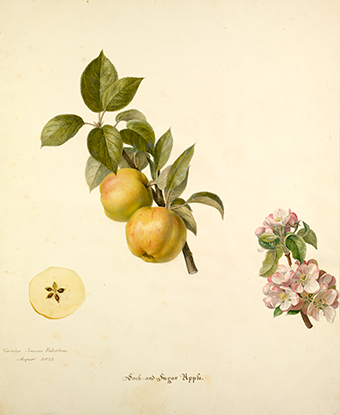
From the outset, fruit was a major focus. The garden became a proving ground for new varieties and a centre for refining fruit nomenclature. Fellows and nurserymen sent in specimens for assessment, and staff classified everything from strawberries to gooseberries. This culminated in the publication of the Catalogue of fruits cultivated in the garden, listing an astonishing 3,825 varieties.
![The Spring Grove Codlin [apple].](../../../pages/38/content/A_HFD_6_2_0001.jpg)
Left: Charles John Robertson, Sack-and-Sugar Apple, 1822. A/HFD/8/9
Right: William Hooker, The Spring Grove Codlin [apple], 1820. A/HFD/6/2
Global Plant Collecting
Between the 1820s and 1860s, the Society dispatched plant collectors across the globe. They sent back seeds and plants which were grown on and studied in the garden at Chiswick. Many of these introductions were reported in John Lindley's four-volume Report upon the new or rare plants which have flowered in the garden of the Horticultural Society at Chiswick.
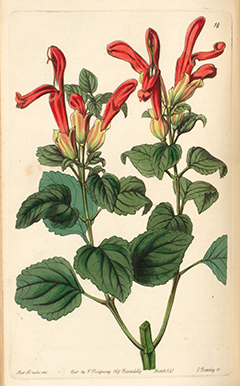
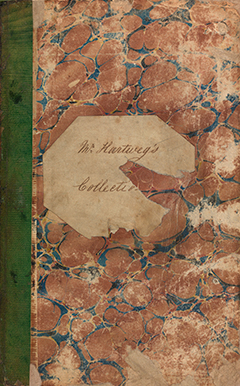

Left: Salvia Regla. Edward’s Botanical Register 27 (1841). BP/95885-1001/27/14: “For this fine Mexican sage we are indebted to Mr. Hartweg, who found it at Aguas Calientes, and sent it to the Horticultural Society.” Centre and right: 'Mr Hartweg's collections', plants received at Chiswick Gardens from Karl Theodor Hartweg. RHS/Col/7/1/3/1
Training the Next Generation
Chiswick was also a training ground. In 1836 the Society introduced its first formal examination for its gardeners, covering botany, vegetable physiology, plan drawing and even accountancy. Young unmarried men aged 18-26 were employed as labourers and shown the ropes in each department. Those who excelled were recommended for roles in private gardens and nurseries.
One such man was a young Sir Joseph Paxton, who so impressed the Duke of Devonshire during his visits to the garden that in 1826 the Duke offered Paxton, who was just twenty-three at the time, the position of Head Gardener at Chatsworth, one of the finest gardens of its time.
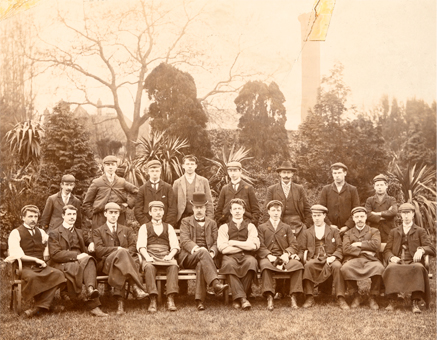
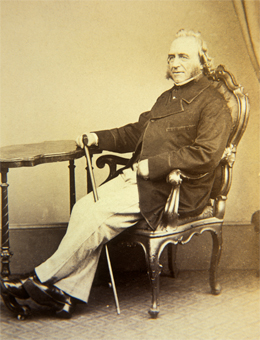
Left: Photograph of the gardeners at RHS Garden Chiswick, 1902. RHS/P/WY/1/18/9
Right: Carte de visite of Sir Joseph Paxton, c.1860s. P/CDV/P/8
The Birth of RHS Flower Shows
In 1827, the Society replaced its annual dinner with a garden fête held at Chiswick. For one guinea, fellows and their guests - women included - could enjoy music, refreshments, and a display of the finest fruits and vegetables, some of which were awarded medals. The show quickly became a highlight of the social season. This event marked the beginning of the RHS flower show tradition.
Early Weather Science
Chiswick was also a site of scientific observation. From 1830 Robert Thompson, Superintendent of the Fruit Department, recorded daily weather data using a barometer, hygrometer, rain gauge, wind vane and a series of thermometers. These observations were published in the Society's Transactions, and in 1871, meteorologist James Glaisher compiled them into a report covering the years 1826 to 1869. The RHS continues to record weather data in its gardens to this day.
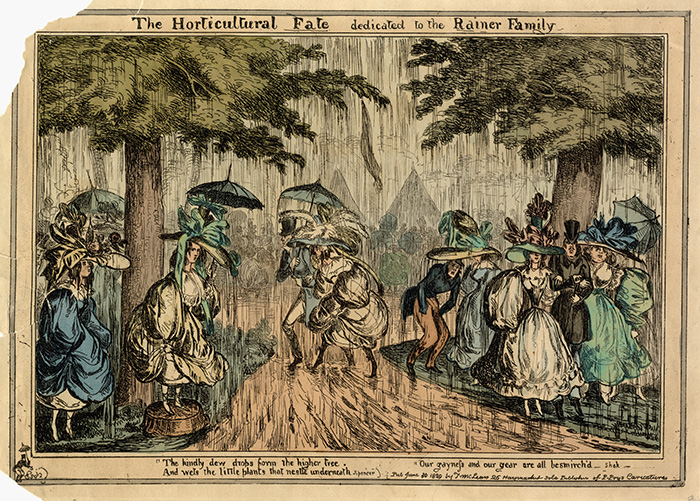
William Heath, 'The Horticultural Fate dedicated to the Rainer Family', 1829
Farewell Chiswick, Hello Wisley
By the late 19th century, the town of Chiswick had changed. Its population had grown from 6,000 to 40,000, and smog from the railways and coal fires in local homes had damaged the Horticultural Society garden’s plants and glasshouses. In 1903, philanthropist Sir Thomas Hanbury acquired the late George Fergusson Wilson's garden at Wisley and gifted it to the Society. The garden at Chiswick closed, its plant collections dispersed or auctioned off, and RHS Garden Wisley officially opened in 1904.
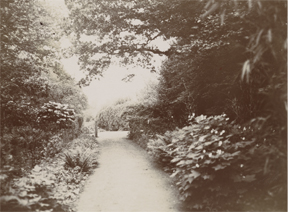
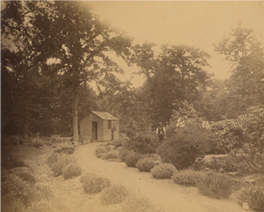
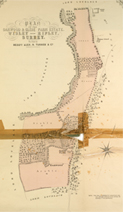
Left: Photograph of the original entrance to Oakwood, now RHS Garden Wisley, c.1890. RHS/P/WY/1/13/B/4
Centre: Photograph of G.F. Wilson in the Wild Garden at Oakwood, now RHS Garden Wisley, 1899. RHS/P/WY/1/18/4
Right: Map of Wisley. 1902.
Discover more
Explore the Chiswick Garden on RHS Digital Collections
Author
Helen Winning, Project Archivist, RHS Lindley Library
Published
16 October 2025
Insight type
Short read