Insights into our collections
Painted leaves: tracing the history of a remarkable botanical book
Who owned this extraordinary botanical dictionary, and why is it filled with paintings? Follow its journey through generations of women.
A practical book with an unexpected secret
At first glance, Richard Watson Dickson’s A complete dictionary of practical gardening looks like a typical early 19th-century reference work. Published in 1807 under the pen name Alexander McDonald, it provided guidance to gardeners cultivating plants and designing gardens.
The RHS Lindley Library’s copy, however, is anything but ordinary. Across its two volumes, hundreds of pages are transformed by delicate botanical watercolours. Painted directly onto the printed text, these images turn a practical manual into a deeply personal work of art.
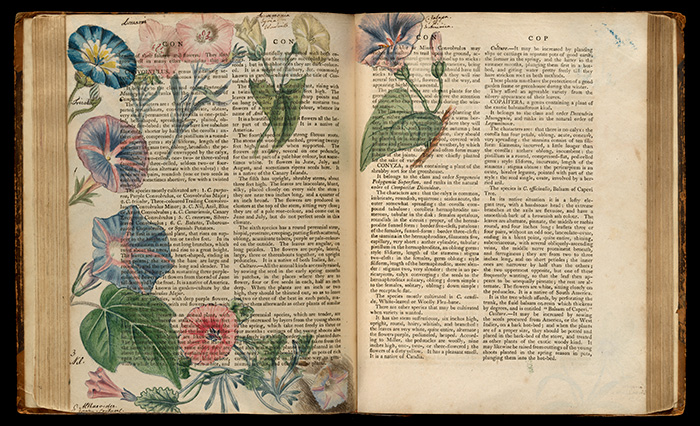
Even more remarkably, the book carries traces of its ownership across more than a century. Through inscriptions, annotations and archival research, it has been possible to reconstruct a largely female-led history of this unique object.
Clues in the margins
The key to this story lies in the handwritten inscriptions at the front of the first volume. These record a sequence of names, dates and instructions that allowed the book’s ownership to be traced across generations.
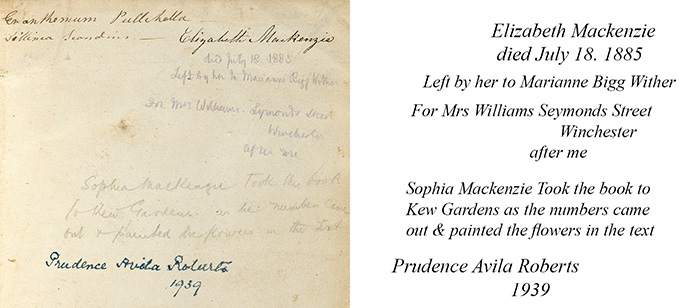
Inscriptions on page 7 of volume 1
From these crucial pieces of evidence, combined with genealogical and archival research, a chain of ownership emerges. We now know that the book passed through the following hands:
- Sophia Mackenzie – the original owner and artist
- Elizabeth Mackenzie – her granddaughter
- Marianne Bigg-Wither – Elizabeth’s relative and neighbour
- Laura Agnes Williams – a later recipient in Winchester
- Prudence Avila Roberts – the 20th-century owner who donated it to the RHS
The artist: Sophia Mackenzie
The dictionary’s earliest identifiable owner is Sophia Mackenzie, who is almost certainly responsible for its extraordinary illustrations.
Born in November 1763, Sophia Gostling was one of 19 children. Her father was the wealthy and well-connected Proctor of the Admiralty George Gostling, of Whitton Park, Middlesex, an impressive estate close to Kew Gardens.
Sophia married James Mackenzie on or around her 40th birthday in 1803, moving from her home in Whitton to the Isle of Wight.
The discovery of her will not only confirms the book’s next owner (her granddaughter, Elizabeth Mackenzie) but also provides important insight into her interests. It shows that she owned books on natural history and collections of curiosities, suggesting a deep engagement with the natural world.
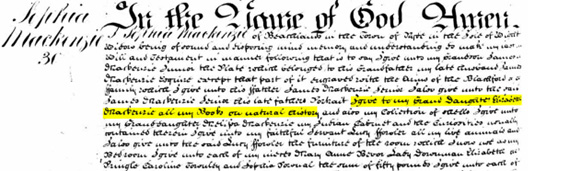
“I give unto my Grand Daughter Elizabeth Mackenzie all my books on natural history and also my collection of shells. I give unto my Grand Daughter Melissa Mackenzie my India cabinet and all the curiosities usually contained therein…” [image courtesy of The National Archives PROB 11/1880/186]
Reading the will, it’s evident Sophia had a keen interest in natural history, including botany and was an avid watercolour painter. Creative and botanically intrigued, she is the perfect character to paint our dictionary.
How to paint a book
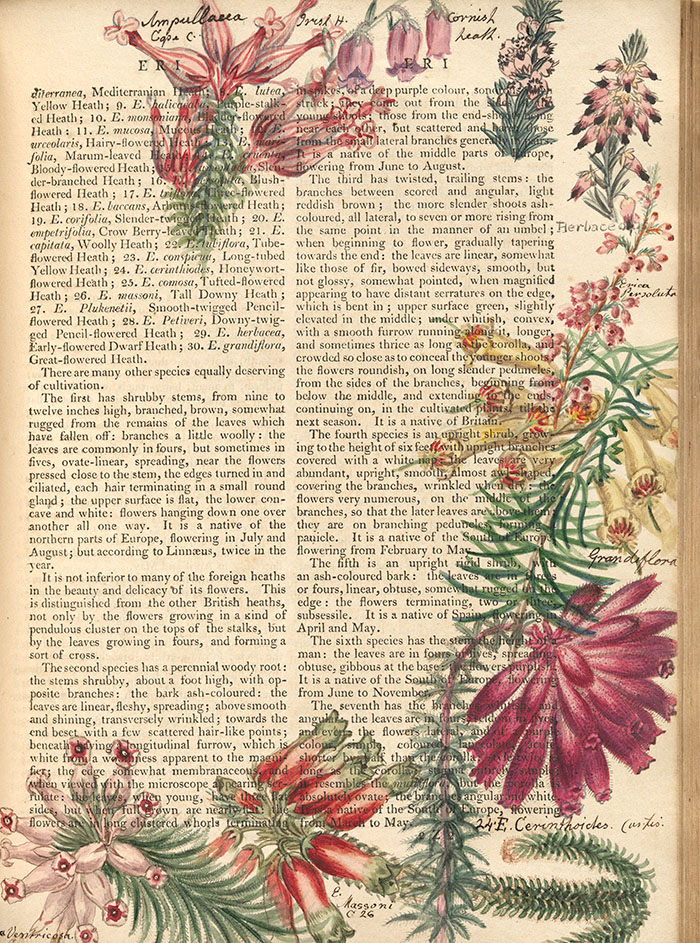
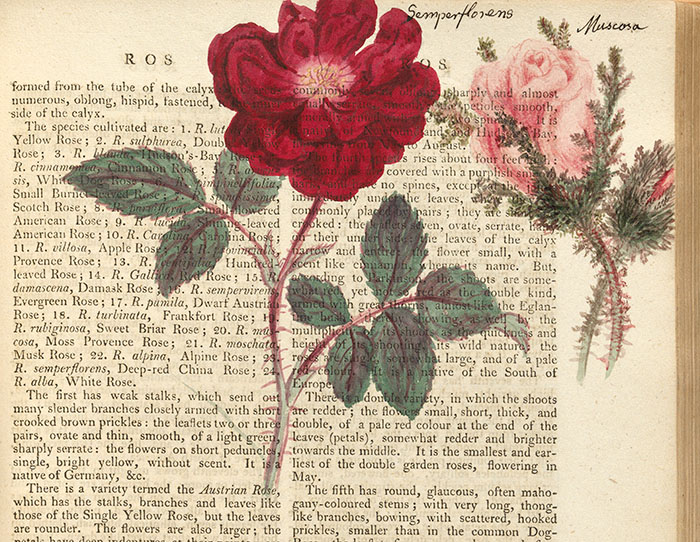
Sophia’s unusual watercolours depict a vast array of plants including garden varieties and species that grow wild in the UK. Most are of plants featured in the dictionary’s text, but a few appear simply to be plants that intrigued Sophia, added as her own personal record.
Sophia drafted her designs first in pencil, then laid colour washes over the top. Some remained unfinished, left simply as pencil outlines. Marks in the margins hint at where she planned to create pictures later.
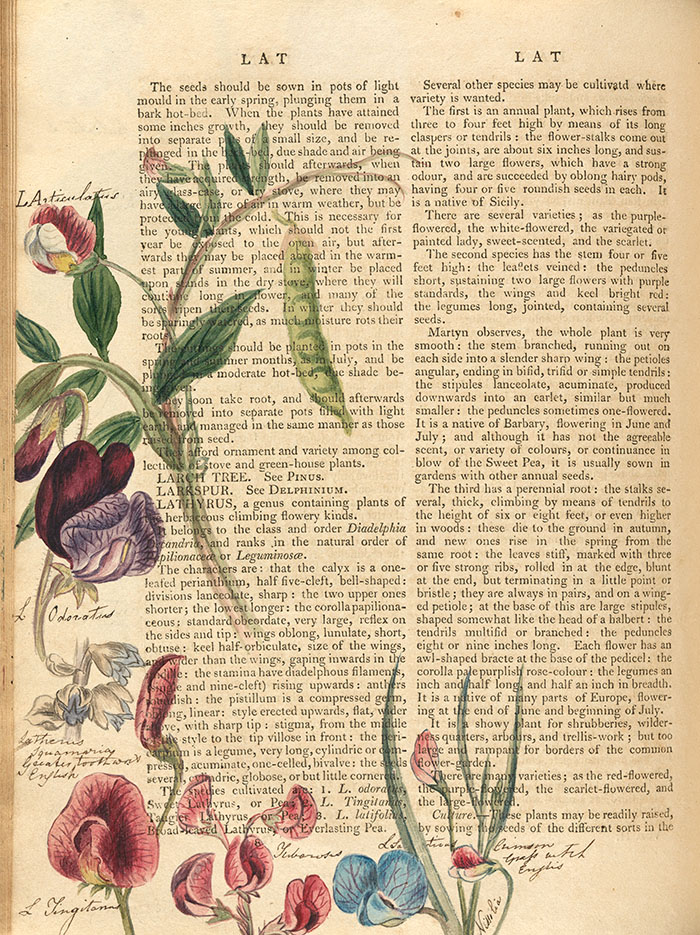
Sophia also annotated her dictionary, first in pencil, then in ink. Many of these annotations include labels like “Curtis” and “English” - clues that Sophia was copying and adapting illustrations from a range of popular botanical works including William Curtis’s Botanical Magazine, James Edward Smith’s English Botany, and William Woodville’s Medical Botany.
Sophia would often group together multiple plant portraits from a variety of sources to create striking collage-like effects. Identifying the plants, finding illustrative plates and creating her artistic compositions, would have been a time-consuming and painstaking labour of love.
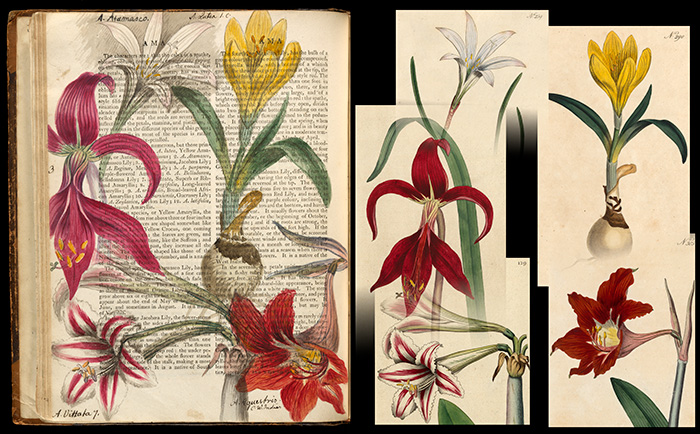
Left: Page 74 of volume 1. Right: Corresponding images from Curtis's Botanical Magazine: Pl.47. Amaryllis formosissima (1787); Pl.129. Amaryllis vittata (1790); Pl.239. Amaryllis atamasco (1793); Pl.290. Amaryllis lutea (1795); Pl.305. Amaryllis equestris (1795)
One book we know she copied from - Woodville’s Medical botany - can be definitively placed in her personal library, because she left it to her friend George Henry Ward in her will. Other paintings are yet to be matched with a printed counterpart. These may be original or simply drawn from yet unidentified works.
Passing to Elizabeth Mackenzie
Sophia died in 1837, and her will indicates that books on natural history were left to her granddaughter Elizabeth Mackenzie.
Elizabeth’s specific death date is noted in the book’s inscription, making her easier to identify in the historic record.
Born in 1799 to James Mackenzie and Elizabeth Arundell, Elizabeth Mackenzie spent most of her life in Winchester. She never married and had no children, living independently at 18 Southgate Street where the dictionary sat on her shelves, prized for nearly 50 years.
A family connection: Marianne Bigg-Wither
>When Elizabeth died in 1885, the book passed to Marianne Bigg-Wither. Marianne’s surname, Bigg-Wither, will be familiar to Jane Austen enthusiasts. Marianne’s father, Harris Bigg-Wither, was famously engaged to Austen for less than 24 hours before she broke things off - an episode that shaped her writings.
The relationship between the two women explains this transfer. They were second cousins once removed as well as neighbours: Marianne also lived on Southgate Street at number 4. In the absence of direct descendants, Elizabeth likely chose someone within her extended family and social circle to inherit the book.
From Marianne to the Williams family
After inheriting the dictionary in 1885, it was Marianne who recorded Elizabeth’s death date in the inscription and wrote instructions to pass the volumes later to “Mrs Willams Seymonds Street Winchester”. Like her cousin, Marianne was unmarried and without children, so what was her connection to Mrs Williams?
Census records show that Marianne moved within Winchester to 65 Kingsgate Street sometime after 1881. Down the road at 8 Kingsgate Street lived Laura Agnes Williams and her family. Critical to our story, by 1891 Laura was living on Seymonds Street with her daughters – the only Williams family residing there at the time, providing a match to our inscription.
Marianne died in 1900, leaving the volumes to Laura who held them briefly until she passed away in 1902. Here our dictionary’s history becomes a little unclear as we have yet to establish the link between Laura and Prudence Avilla Roberts.
Prudence Avila Roberts and the RHS
By 1939, the book was in the possession of Prudence Avila Roberts. Prudence was the great-granddaughter of William Andrews Nesfield – the landscape designer behind the RHS’ Kensington garden.
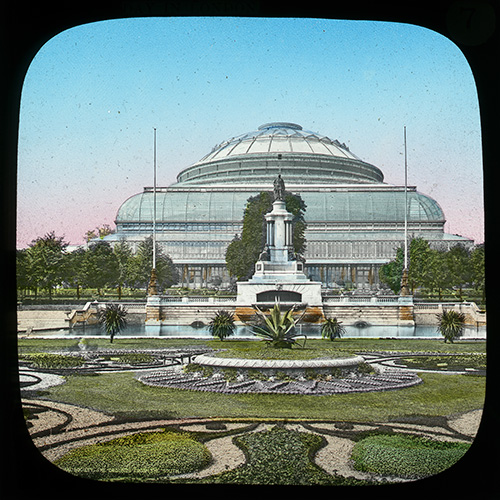
Lantern slide showing garden at South Kensington RHS/P/KG/5/11
Prudence later married into the Bosanquet family and, in 1977, donated the volumes to the RHS Lindley Library, ensuring their long-term preservation and making them accessible for research.
Painting at Kew
Returning to the book’s inscriptions, another intriguing detail suggests that Sophia Mackenzie visited Kew Gardens to paint the plants she recorded. This raises important questions about access and practice.
Whether Sophia carried the dictionary and sourcebooks with her, rather than simply visiting Kew to identify plants in person, is impossible to know. What is certain is that her paintings must have been produced between 1807, when the dictionary was first published, and 1837, the year of her death.
Her visits are particularly interesting because they took place before Kew became the public institution we know today. In 1840, ownership passed from the Crown to the Government and the site became the Royal Botanic Gardens, Kew. Before then, it remained largely a private royal estate.
This raises the question of how Sophia gained access to the gardens. Her marital home on the Isle of Wight was many miles away, across the Solent from Kew. Visits to family in Whitton, or trips connected to James's business interests, may have brought her to the area. However, recording the large number of plants she eventually painted would have required multiple visits and potentially lengthy stays.
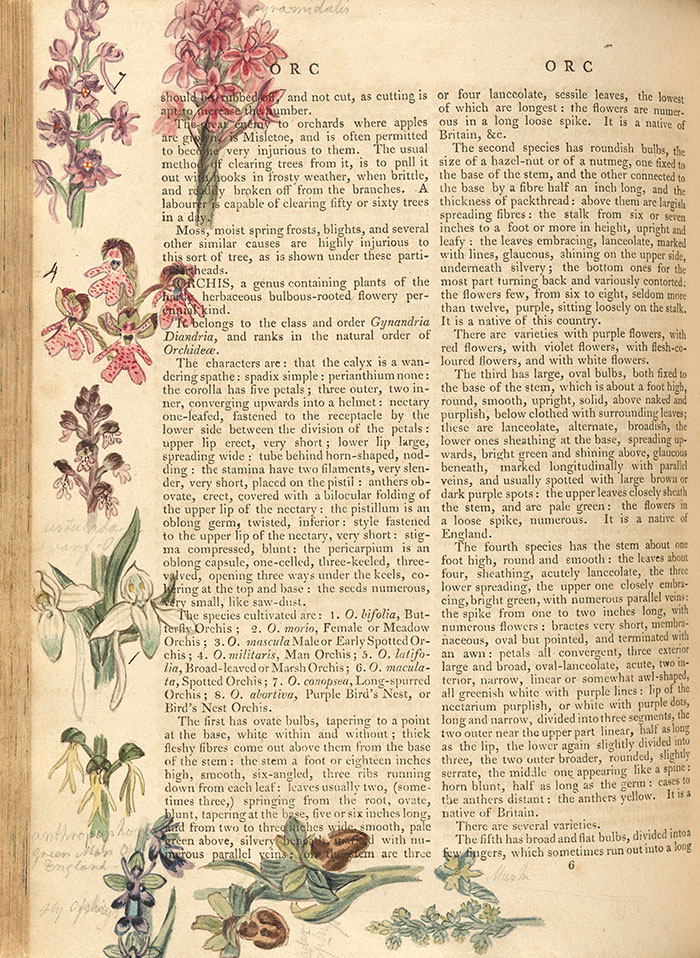
Vol 2. p. 180 (Pyramidal Orchid, seen top right = county flower of the Isle of Wight)
The extent of public access to Kew in the early nineteenth century is not entirely clear. Before 1845, the site was divided into the Pleasure Grounds and the scientific Botanic Gardens. Reports from 1819 and 1825 suggest that the Pleasure Grounds were open to the public one day a week between Midsummer and Michaelmas (24 June to 29 September), while entry to the Botanic Gardens was more tightly controlled. Writing in 1838, the botanist John Lindley suggested that Kew had by then become accessible every day, although this change came too late to explain Sophia's earlier visits.
Digging deeper
By assessing the flowering times of the species Sophia illustrated, further research is underway to gauge when she was likely making her trips and if they sat within sanctioned visiting periods. Similarly, we are examining the plants she depicted to gain insights into whether they were specimens likely grown in the Botanic Gardens or flowerbeds associated with the Pleasure Grounds – helping to potentially determine which parts of the gardens she frequented.
A valuable source of information in this research is Hortus Kewensis, a catalogue detailing what was being grown at Kew. It offers information about when plants were introduced, their flowering times and indications of where they were grown (e.g. greenhouse or stove).
As more pages in our dictionary’s history turn, ongoing research will reveal more of its story and uncover further details about the lives of its owners and their links, as well as the artworks that inspired its illustrations. It is a true treasure – not only for its beautiful paintings and richly detailed and feminine ownership history, but also because it is a unique, visual horticultural record of a royal garden – a standing testament to one woman’s intellectual curiosity, meticulous research ability and artistic skill.
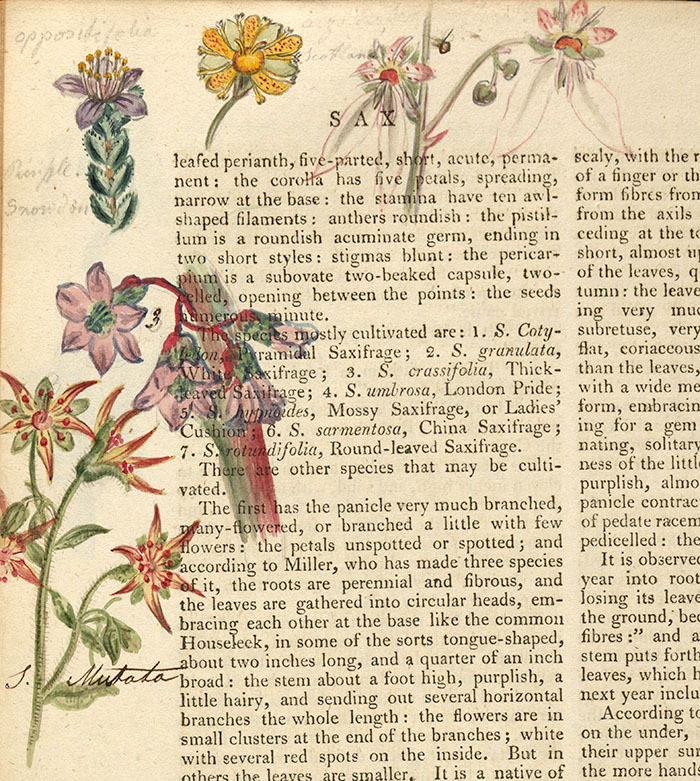
Page 398 of volume 2
Discover more
Alexander McDonald, A complete dictionary of practical gardening, Vol. 1
Alexander McDonald, A complete dictionary of practical gardening, Vol 2
Author
Jessica Hudson, Rare Books Librarian, RHS Lindley Library
Insight type
Long read