Insights into our collections
Dig for Victory: The RHS and the Gardening Army
The Vegetable Garden Displayed, the RHS’s guide to growing vegetables produced for the Dig for Victory campaign, remains the Society’s most successful publication ever. Find out how the RHS helped to keep Britain fed during the Second World War.
Spades Not Ships: A Nation at Risk
The spectre of food shortages loomed large as Britain entered the Second World War. Memories of the First World War were still fresh: between 1914 and 1917, German U-boat attacks had sunk an estimated six million tons of food imports. By the late 1930s, the number of allotments had halved, and the country remained dangerously reliant on overseas supplies.
The British government responded in 1940 by launching the Dig for Victory campaign: a national ‘call to spades’ aimed at mobilising the public to grow their own food. People responded in their millions, and Britain’s gardens and parks quickly became battlegrounds for survival. Many had never grown vegetables before, so the RHS stepped in to offer crucial support.
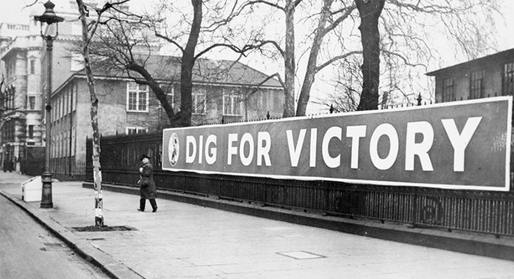
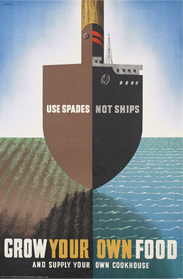
Left: Ministry of Information Campaign poster, London, UK, 1940
Right: Abram Games, Use Spades not Ships poster. Credit: IWM (Art.IWM PST 2916)
The Vegetable Garden Displayed – a ‘how-to’ guide for growing food
Published in 1941, The Vegetable Garden Displayed was the RHS’s flagship contribution to the Dig for Victory campaign. The how-to guide featured more than 300 photos – taken at RHS Garden Wisley – accompanied by clear step-by-step instructions for key growing tasks like digging drills, sowing seeds and thinning seedlings.
Packed with tips on everything from good digging technique to the selection of reliable varieties, it assumed no prior knowledge and made growing accessible to all.
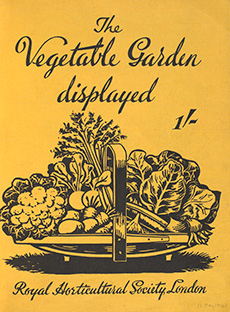
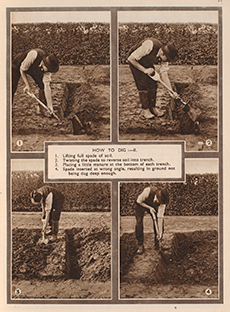
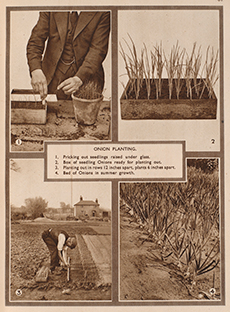
Front cover and pages from the first edition of The Vegetable Garden Displayed, 1941
A Clear Message: Flowers Out, Food In
The guide aligned closely with government messaging, offering a unified voice in a time of crisis. Forewords by Robert Hudson, Minister of Agriculture and Fisheries, and Lord Woolton, Minister of Food, underscored the urgency of the Dig for Victory Campaign.
Woolton’s words were particularly striking:
“This is a Food War. Every extra row of vegetables in allotments saves shipping. If we grow more Potatoes we need not import so much Wheat … We must grow more onions. We can no longer import ninety percent of them as we did before the war.”
The guide marked a shift in public perception of the RHS. Previously associated mainly with ornamental gardening and Chelsea Flower Show, the Society now stood as a champion of practical horticulture. The message was clear: flowers were out, food was in.

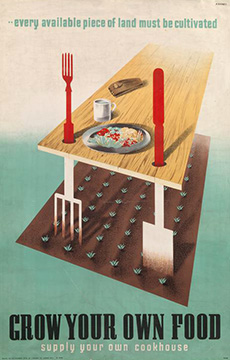
Left: Irene Mitchell, Dig for Victory now poster. Credit: IWM (Art.IWM PST 17009)
Right: Abram Games, Grow your own Food poster. Credit: IWM (Art.IWM PST 2893)
An overwhelming response
Determined to make the guide affordable, the RHS had The Vegetable Garden Displayed printed in black and white and bound in softcover. The first edition sold for just one shilling (around £2 today). Its popularity was immediate and overwhelming: the initial print run of 25,000 copies sold out quickly, prompting successive reprints of 25,000 and then 50,000 copies by Christmas 1941.
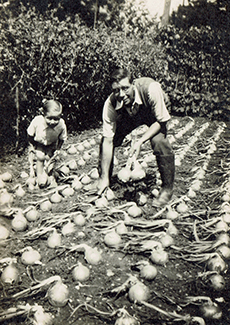
The response from the public was swift and resounding. By 1943, Britain was home to 3.5 million allotments producing over a million tonnes of vegetables. All manner of growing spaces were transformed into veg plots: not just gardens, but parks, golf courses, and even the moat of the Tower of London.
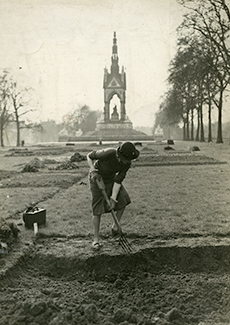
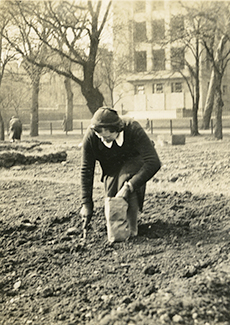
Left: Photograph of Isabel Beech digging in front of the Albert Memorial, Kensington gardens, during the Dig for Victory campaign, c.1940. RHS/P/DFV/1/15
Centre: Photograph of Roger Staker and his father Clifford Staker in their garden in Bognor Regis during the Dig for Victory campaign, c.1945. RHS/P/DFV/1/9/2
Right: Photograph of Phyllis Newbury sewing seeds at The Meadows, Edinburgh, during the Dig for Victory campaign, May 1941. RHS/P/DFV/1/10/2
A Lasting Legacy
The Vegetable Garden Displayed remains to this day the RHS’s most successful publication. Its influence extended far beyond the printed page. Shortly after its release, the photographic lantern slides used in the book went on tour and were used in gardening lectures across the country. Later, they were transformed into travelling exhibition boards, displayed in town halls, schools, and public spaces. Incredibly, a set of these boards survived and was found in an Isle of Wight scout hut some 60 years later.
Today, a digitised first edition of The Vegetable Garden Displayed is available to view on RHS Digital Collections, as well as numerous photographs of vegetable plots created in response to the Dig for Victory. These resources offer a window into a pivotal moment in British history, when gardening became a patriotic act and the RHS helped cultivate not just vegetables, but resilience.
Discover more
View items on RHS Digital Collections relating to the Dig for Victory campaign
Author
The Library Team, RHS Lindley Library
Published
16 October 2025
Insight type
Short read