Insights into our collections
Botanical art in the Georgian drawing room
In the elegant drawing room of a Wiltshire stately home now lost to time, a story unfolded that links a group of talented sisters, an art tutor to royalty, and the beloved novelist Jane Austen.
This is the story of the Smith sisters: Maria, Elizabeth (sometimes known as ‘Eliza’), Augusta, and Emma, and how their beautiful botanical art came to be in the collections of the RHS Lindley Library.
At home with the Smith sisters
The four Smith sisters grew up in Erle Stoke Park near Devizes, Wiltshire. Their parents were Joshua Smith MP, a director of the East India Company, and Sarah Gilbert, whose father Nathaniel was a member of the legislative council of Antigua and a slave-owner. Set on a hill, the Smiths' grand, neoclassical home stood in an expansive parkland complete with pleasure grounds, a winding valley, a cascading stream. An 1816 account describes how “The rural village of Earle Stoke is supposed to be one of the neatest in the kingdom. Most of the houses have been erected by Mr. Smith, who has added to each a sufficiency of garden ground. All the fronts are adorned with flower gardens and evergreens, and the whole has a very pleasing effect.” An idyllic place, it would seem, to cultivate four budding young botanical artists.
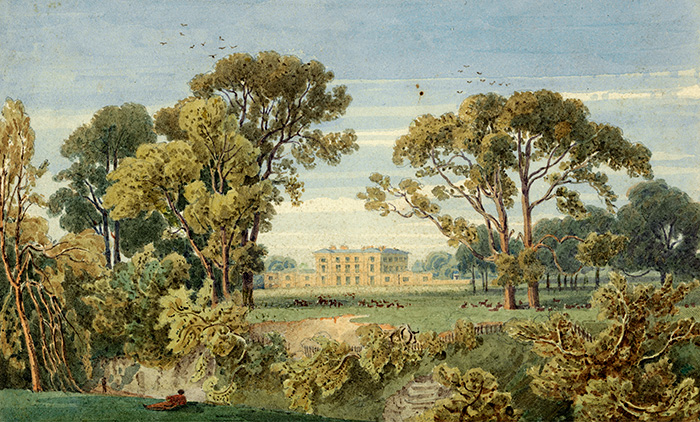
Erlestoke house and park
Credit: Yale Center for British Art, Paul Mellon Collection
Margaret Meen: the Smith sisters’ artistic mentor
Central to the sisters’ artistic development was Margaret Meen (1751–1834), a distinguished botanical artist and mentor. Born in Norfolk and later based in London, Meen was renowned for her delicate watercolours, often on vellum, and her instruction of elite pupils including Queen Charlotte, wife to George III.


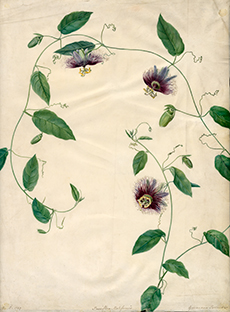
Left: Margaret Meen, Strelizia reginae, c.1790
Centre: Margaret Meen, Solandra grandiflora, 1780
Right: Margaret Meen, Passiflora maliformis, 1789
Meen began to instruct the Smith sisters in botanical artistic technique around 1784, with their lessons continuing into the early 1790s. Meen would also go on to teach Augusta’s daughter, another Emma Smith (later Austen-Leigh), from 1815 onwards, continuing her influence into the next generation. Letters show that Meen travelled to wherever Emma was – whether at her London or Essex home – giving a sense of the importance placed on Emma’s artistic education by her family.


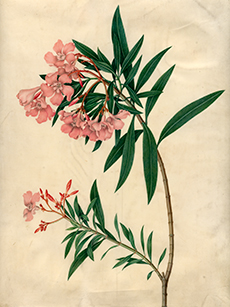
Left: Attributed to Augusta Smith, Monarda punctata, 1787
Centre: Attributed to Augusta Smith, Tropaeolum, 1787
Right: Attributed to Augusta Smith, [Nerium oleander], c.1780
Scientific enquiry through botanical art
This training formed part of a broader cultural phenomenon. Botanical illustration was not merely a genteel pastime; it was a way for women to engage with scientific inquiry within the bounds of social acceptability and in a domestic setting. Painting flowers required close observation, knowledge of plant anatomy, and an appreciation of natural beauty.
The level of artistic and botanical training the Smith sisters enjoyed was unusual, even for a well-to-do family. Jane Austen’s sister, Cassandra, was a keen and talented artist, but she was self-taught and focussed on family portraits and making copies of prints in books.
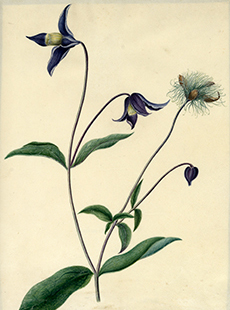
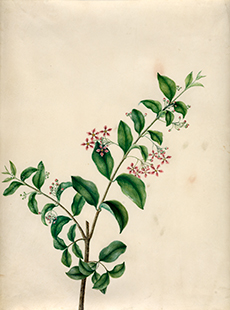
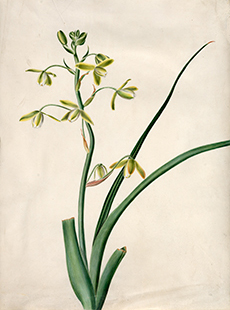
Left: Attributed to Emma Smith, [Clematis viticella], c.1780
Centre: Attributed to Emma Smith, Malpighia, c.1780
Right: Attributed to Emma Smith, Ornithogalum luteum [Albuca altissima], c.1780
The Smith and Austen families: linked in marriage, friendship and literature
The Smith sisters’ social circle overlapped closely with that of author Jane Austen. Elizabeth ‘Eliza’ Smith married William Chute of The Vyne in Hampshire, where Jane’s brother James Austen served as the local vicar. William and James were close friends. Eliza and William’s adopted daughter, Caroline Wiggett, is thought by some to have inspired the character of Fanny Price in Mansfield Park.
![Pyrus spectabulus [Malus spectabilis] by Eliza Smith](../../../pages/34/content/A_SMI_EL_1_0001.jpg)
![[Gazania] by Eliza Smith](../../../pages/34/content/A_SMI_EL_10_0001.jpg)
![[Calycanthus floridus] by Eliza Smith](../../../pages/34/content/A_SMI_EL_9_0001.jpg)
Left: Attributed to Eliza Smith, Pyrus spectabulus [Malus spectabilis], 1788
Centre: Attributed to Eliza Smith, [Gazania], 1784
Right: Attributed to Eliza Smith, [Calycanthus floridus], c.1780
Further family ties connect the Smiths to Austen’s extended family. Augusta Smith’s daughter, also named Emma Smith, married Edward Austen, son of James Austen and nephew to Jane. This Emma, whose married surname was Austen-Leigh (and who was also taught by Meen, as previously mentioned), would later become the biographer of her famous aunt, preserving Austen’s legacy alongside her own artistic pursuits.

Meen and the Smith sisters in the RHS Lindley Collections
The RHS Lindley Library holds a remarkable collection of 19 botanical illustrations by Margaret Meen, and 29 paintings in total attributed to the four Smith sisters (2 to Maria, 12 to Elizabeth, 7 to Augusta, 8 to Emma) on account of their dates, style of work and contextual clues. It is hoped that further research will confirm these attributions.
All were formerly bound as part of an album owned by horticulturist and RHS vice-president Reginald Cory (1871-1934), who generously bequeathed them to the RHS Lindley Library in 1936. There is evidence – including auction catalogues, paper styles and a handwritten note – to suggest that several of the artworks were previously owned by former Prime Minister John Stuart, 3rd Earl of Bute (1713-1792), who had a keen interest in botany and horticulture and had links to Margaret Meen.
![[Senecio elegans] by Maria Smith](../../../pages/34/content/A_SMI_MA_1_0001.jpg)
![Paeonia lusitanica [Paeonia broteri] by Maria Smith](../../../pages/34/content/A_SMI_MA_2_0001.jpg)
Left: Attributed to Maria Smith, [Senecio elegans], c.1780
Right: Attributed to Maria Smith, Paeonia lusitanica [Paeonia broteri], 1784
These paintings are more than aesthetic achievements; they are records of a time when art and science flourished in tandem, and when women, though often excluded from formal institutions, found ways to contribute meaningfully to both.
Discover more
Artworks attributed to the Smith sisters on RHS Digital Collections
Author
RHS Libraries Team, RHS Lindley Library
Published
11 August 2025
Insight type
Short read