Insights into our collections
Harmanis de Alwis: A Botanical Illustrator in Colonial Ceylon
Discover the remarkable paintings of Harmanis de Alwis, the Sri Lankan botanical artist whose artworks continue to inform botanical scholarship today, over a century after his death.
The story of Harmanis de Alwis is one of quiet brilliance and enduring legacy. Born in 1792 in Kalutara, Sri Lanka (then Ceylon), de Alwis rose from modest beginnings to become one of the most prolific botanical illustrators of the 19th century. Over the course of his career, he produced more than 2,000 scientifically detailed illustrations of Sri Lankan flora, many of which continue to inform botanical scholarship today.
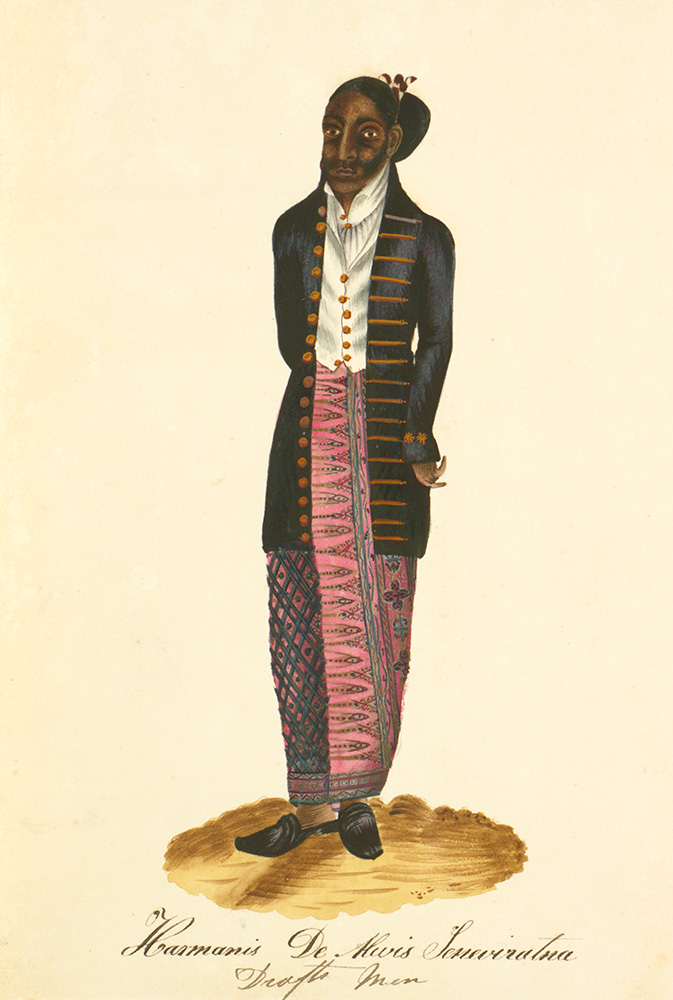
Self-portrait of Harmanis de Alwis Seneviratne. A/CIN/HA/1.
A Career Rooted in Observation
De Alwis began his professional life in 1818 as a clerk – referred to at the time as a “native writer” – at the Kalutara Botanic Gardens. His appointment came under the supervision of Alexander Moon, the British superintendent of the gardens. Moon quickly recognised de Alwis’s artistic potential and personally funded his training in botanical illustration. This enabled de Alwis to begin documenting the island’s plant life with remarkable precision and care.
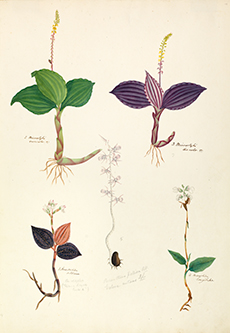
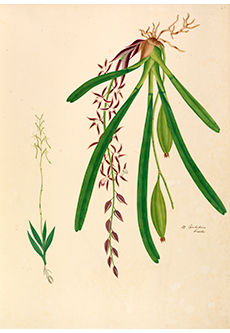
![[Drosera burmanii; Lindernia cordifolia; Lindernia pusilla; Liparis viridifolia; unidentified plant], page 4-5](../../../pages/31/content/A_CIN_HA_4_0001.jpg)
Paintings by Harmanis de Alwis
A Garden on the Move
In 1822, the Botanic Gardens were relocated to a cooler and more fertile site in Peradeniya, near Kandy, due to unsuitable conditions in Kalutara. De Alwis moved with them and was appointed official draughtsman the following year. From this new base, he continued to explore the island’s forests, returning with both plant specimens and meticulously rendered illustrations. His work was not only artistic but also scientifically accurate, often including detailed dissections.

Map of Royal Botanic Garden, Peradeniya. A/CIN/HA/2
Recognition and Responsibility
In 1831 Britain’s colonial administrators in Sri Lanka awarded de Alwis the title of Muhandiram. In 1854 he was further honoured with the title of Mudaliyar. This involved acting as a ‘headman’, intermediary and interpreter between the colonial administration and the local population. De Alwis would have worn a uniform, advised the Governor on local matters, and helped with revenue collection and local control. These titles, while reflective of colonial hierarchies, acknowledged his significant contributions to botanical science and would have afforded him significant power and influence. Upon receiving these honours, he adopted the additional name Seneviratne, a surname that his descendants continue to use.
De Alwis’s work was instrumental in the production of early botanical texts in Sri Lanka. He assisted Moon in compiling a bilingual catalogue of local plants, one of the first books to be printed in Sinhala. His illustrations were also used by subsequent directors of the Peradeniya Gardens, including George Gardner and George Henry Kendrick Thwaites, both of whom praised his skill and dedication.
A Family Affair
The legacy of Harmanis de Alwis did not end with his retirement in 1861 – his sons, William and George, inherited his talent and carried on his life's work. William de Alwis succeeded him as draughtsman at Peradeniya and went on to become a distinguished illustrator in his own right. William’s most notable achievement was a series of watercolours depicting over 350 species of Sri Lankan butterflies and moths, many shown in multiple life stages and alongside their host plants.
Several of Harmanis’s grandsons also worked as illustrators and photographers at the Peradeniya Gardens and other institutions in Sri Lanka and Singapore. Their work supported a wide range of scientific publications, from botanical monographs to zoological studies.
Harmanis lived to the age of 101, passing away in 1894. He and his son William are buried together in Kandy, their gravestone a quiet tribute to a family whose art helped shape the scientific understanding of South Asia’s biodiversity.
.jpg)
.jpg)
.jpg)
Artworks by George de Alwis. Source: Wikimedia Commons.
A Legacy Preserved
The RHS Lindley Library holds an important volume of drawings made in Sri Lanka, most of which are by Harmanis de Alwis. The volume was sent to John Lindley by the Society’s former plant collector James McRae after he had become Director of the Peradeniya Botanic Garden in 1827.
Collections of the de Alwis family’s illustrations are held in institutions around the world, including the Royal Botanic Gardens, Kew; the Natural History Museum, London; and the Singapore Botanic Gardens. In Sri Lanka, illustrations are preserved at the National Herbarium in Peradeniya and the National Museum in Colombo, among others. Their work remains a testament to the power of observation, and the value of artistry within science.
Discover more
Author
RHS Libraries Team, RHS Lindley Library
Published
19 June 2025
Insight type
Short read