Insights into our collections
Pressed Plants and Priceless Pages: The Story behind Flora Graeca
Discover more about the ten-volume 19th-century masterpiece Flora Graeca. Is this the most expensive book ever published?
In the world of botanical publishing, few works rival the ambition – or the price tag – of Flora Graeca. Produced over more than three decades, this ten-volume 19th-century masterpiece is often called the most expensive book ever published. Behind its lush illustrations and Latin names lies a story of collaboration.
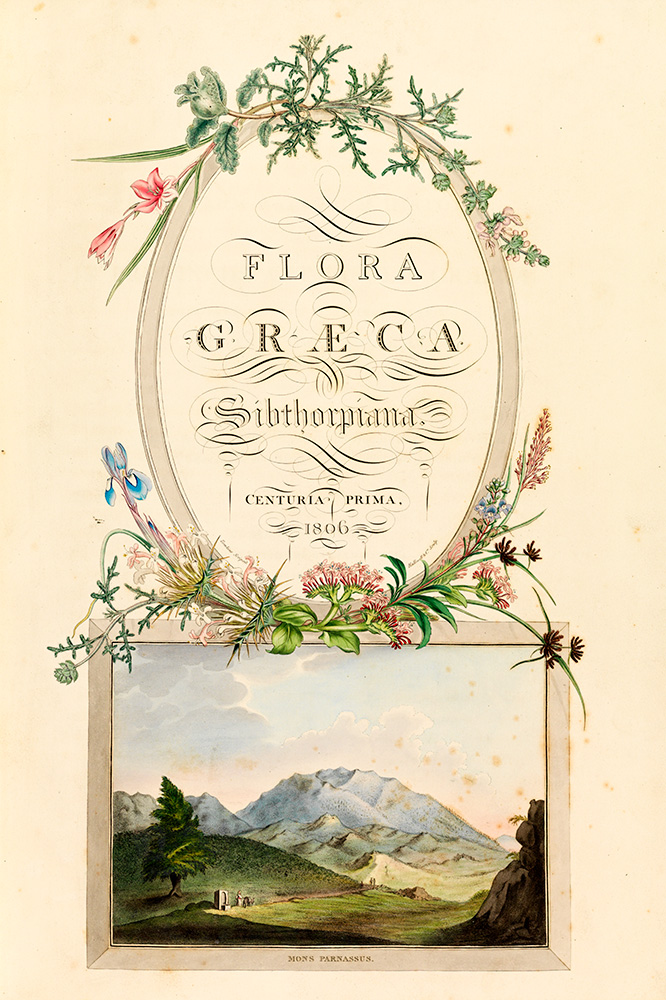
Expedition to the eastern Mediterranean
The project began in the 1780s, when John Sibthorp, Oxford’s third Sherardian Professor of Botany, was awarded the Radcliffe Travelling Fellowship. With its generous stipend, Sibthorp set out to document the flora of the eastern Mediterranean – a region that, while botanically rich, had not yet been the subject of a formal scientific survey. His work was part of a broader movement in European science to describe and catalogue the natural world, often through expeditions supported by universities, learned societies, and private patrons.
![Herbarium specimen of Morina persica [Persian whorlflower] collected by Sibthorp in Greece](../../../pages/30/content/WSY0122761.jpg)
![Illustration of Morina persica [Persian whorlflower] by Bauer](../../../pages/30/content/10699-1001_pl28.jpg)
Herbarium specimen of Morina persica [Persian whorlflower] collected by Sibthorp in Greece, next to the final illustration by Bauer in Flora Graeca Volume I
Sibthorp’s two journeys to the Levant (1786–87 and 1794–95) were not solo ventures. On his first trip, he was accompanied by Ferdinand Bauer, a highly skilled botanical illustrator whose drawings would later become central to Flora Graeca. The journey would take would them through what is now the Netherlands, Germany, the Czech Republic, Austria, Slovenia, Italy, Greece, Turkey and Cyprus. The specimens they collected were pressed, sometimes labelled, and brought in great number to Britain for further study.
![Herbarium specimen of Fraxinus ornus [manna ash] collected by Sibthorp in Greece](../../../pages/30/content/WSY0131344.jpg)
![Illustration of of Fraxinus ornus [manna ash], by Bauer](../../../pages/30/content/10699-1001_pl4.jpg)
Herbarium specimen of Fraxinus ornus [manna ash] collected by Sibthorp in Greece, next to the final illustration by Bauer in Flora Graeca Volume I.
The most expensive book ever published?
Sibthorp died in 1796, but he left behind both his collections and the funds to publish them. The task of turning his fieldwork into a finished publication fell to others. Botanist James Edward Smith took on the challenge of identifying and naming the specimens, writing the accompanying text, and overseeing the early volumes. Bauer completed the illustrations, sometimes working from the preserved plants. Later volumes were written by John Lindley of the Horticultural Society.
The result was a monumental work: ten volumes published between 1806 and 1840, at a cost of over £15,500 – equivalent to more than £6 million today. Only 25 complete sets were ever produced, each one a triumph of scientific publishing and artistic craftsmanship. We hold one of these rare sets in the RHS Lindley Library.
![Herbarium specimen of Corispermum hyssopifolium [bugseed or winged pigweed] collected by Sibthorp in Turkey](../../../pages/30/content/WSY0115081.jpg)
![Illustration of of Corispermum hyssopifolium [bugseed or winged pigweed] by Bauer](../../../pages/30/content/10699-1001_pl1.jpg)
Herbarium specimen of Corispermum hyssopifolium [bugseed or winged pigweed] collected by Sibthorp in Turkey, next to the final illustration by Bauer in Flora Graeca Volume I.
Sibthorp’s herbarium specimens
In 1936, the RHS received a donation of 12,000 plant specimens from Frederick Janson Hanbury. Hanbury was a businessman, botanist and entomologist whose brother Thomas gifted the land that would become RHS Garden Wisley to the Society in 1903. Among the herbarium specimens Hanbury donated were around 25 collected by Sibthorp himself during his expeditions to the Levant for the Flora Graeca.
These specimens are part of a wider network of collections. The University of Oxford holds the original illustrations and the full herbarium set. Royal Botanic Gardens, Kew has around 100 Sibthorp specimens, donated in 1902. The RHS’ 26 specimens are particularly notable for the paper on which they are mounted - made by J. Whatman, the same manufacturer used for Wellington’s dispatches at Waterloo and Napoleon’s will.
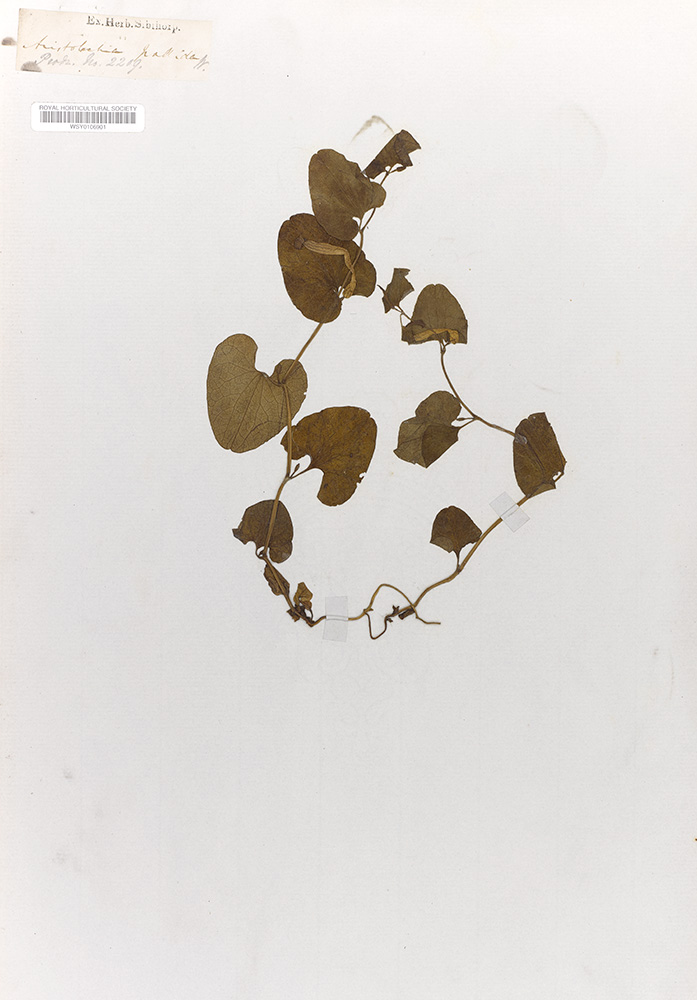
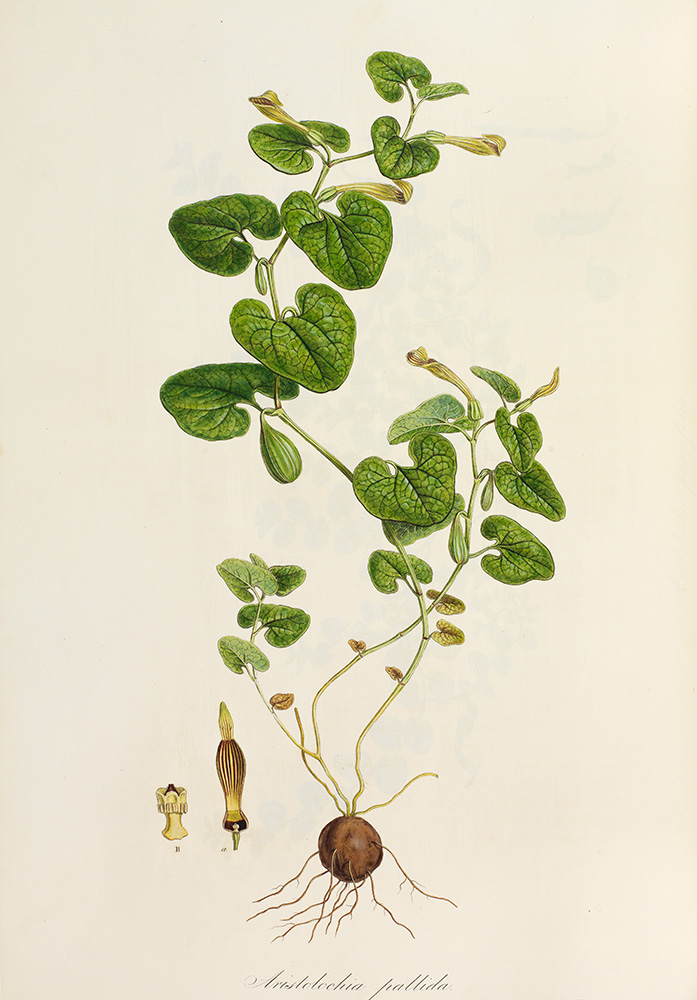
Herbarium specimen of Aristolochia pallida Willd. collected by Sibthorp in Greece, next to the final illustration by Bauer in Flora Graeca Volume X.
The making of Flora Graeca reveals the collaborative nature of botanical science—where collectors, illustrators, editors, and institutions all played a role in transforming fieldwork into one of the most extraordinary books ever made.
Discover more
Author
Yvette Harvey, Keeper of the Herbarium, RHS
Published
3 June 2025
Insight type
Short read